Pamela Stirling
The Pale HorsePamela Stirling, known as Poppy, first appears as David Ardingly’s companion at the Fantasie, where her apparently frivolous manner leads others to underestimate her. Yet she is the first person in the group to suggest that murder might be arranged for ordinary people, and her response to Mark Easterbrook’s questions about the Pale Horse signals that she knows more than she has said. Her brief appearances help turn casual conversation into a trail of inquiry, and later make her a source of information for Ginger.
Identity and Social Presentation
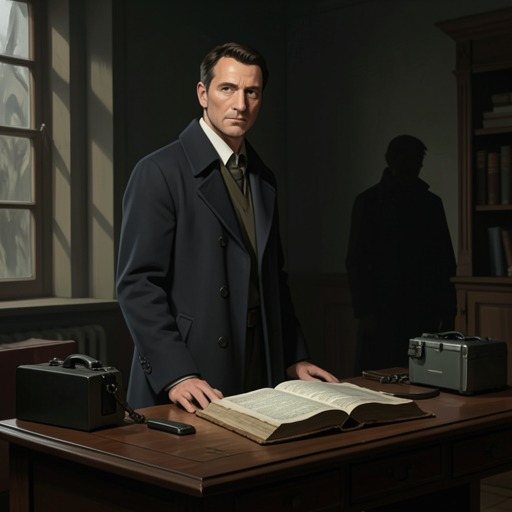
At the Fantasie, David introduces Pamela as his particular pet and presents her as a fashionable, silly girl. The narration describes her as very pretty, with enormous blue eyes and an elaborate hairstyle whose ends and pieces stick out at improbable angles. Her mouth is usually half open, a detail that reinforces the impression of vacant surprise that David and the group attach to her. The description gives her an immediately recognizable presence, but it also shows how readily she is reduced to her appearance and to other people’s judgments.
David’s account of Pamela is especially dismissive: he calls her empty-headed and says she will believe anything, while recommending that Mark take her out as a relaxing companion. He also says she works at an artistic flower shop in Mayfair, where the arrangements are expensive and unconventional. This information gives Pamela a practical identity beyond David’s teasing description, even as his remarks encourage Mark to treat her as an easy person to talk to rather than as an independent source of knowledge.
The contrast between this portrait and Pamela’s contribution at dinner is central to her introduction. She is not presented as a conventional detective or as someone who controls the investigation. Instead, her importance emerges from a remark that the others could easily have passed off as another piece of frivolous conversation.
The Dinner-Table Suggestion
While Mark, Hermia Redcliffe, David, and Pamela sit together at the Fantasie, David imagines how convenient it would be if a person could simply order murderers to remove an inconvenient relative or business rival. The group laughs, treating the idea as a joke. Pamela then says that one can, in a way, do that. Her brief intervention changes the character of the conversation: what had sounded like comic speculation now points toward an actual means of commissioning a killing.
The scene makes the clue depend on a sharp difference in how the speakers are heard. David supplies the joke, but Pamela supplies the suggestion that gives it a sinister practical edge. The others turn toward her, and David asks what she means; the exchange places the burden of explanation on the person whom he has just characterized as foolish. Her line does not, by itself, explain the method or establish what she knows. Its significance lies in opening a question that Mark later pursues.
Mark’s Questions and Pamela’s Reaction
After David gives Mark the address of Pamela’s workplace and encourages him to take her out, Mark visits the flower shop. He chooses asparagus fern instead of the unusual leaves he had considered, a choice that Pamela’s estimation of him appears to register unfavorably. While she clumsily drapes the fern around roses, Mark returns to the subject of the Pale Horse, which Pamela had mentioned earlier. At the name, she starts violently and drops both the roses and the fern onto the floor.
The reaction is more revealing than a deliberate explanation would be at this point in the inquiry. Mark has asked a direct question, but Pamela’s sudden movement interrupts the ordinary business of arranging flowers and shows that the subject has struck a nerve. The scene does not yet disclose the extent or source of her knowledge; it establishes that the Pale Horse is not merely an abstract phrase to her. Her earlier remark at dinner and this physical response form a pair of clues: first a hint that murder can be arranged, then visible alarm when Mark names the place associated with that possibility.
Information and Narrative Role
Pamela’s manner makes her useful to the inquiry in a way that David does not anticipate. He believes she will tell Mark anything because she is gullible, but Mark’s conversation with her raises questions that his friend’s casual introduction cannot settle. Pamela is first approached through David’s social connection and then encountered at work, where the flowers provide the immediate setting for Mark’s renewed questioning. Her everyday occupation and unguarded reaction bring the investigation into an ordinary commercial space rather than a secret meeting place.
Later, Ginger tells Mark that she has been working on Pamela and has managed to get information from her after softening her up. Ginger explains that a woman may tell another woman things without feeling that the disclosure matters. Pamela’s contribution to the investigation therefore develops through two distinct encounters: Mark’s question makes her reaction conspicuous, while Ginger’s more private approach draws out information. Pamela reveals Bradley’s contact details to Ginger, giving the investigation a concrete lead beyond the original hints about the Pale Horse.
The narrative uses the gap between Pamela’s reputation and her importance as a small but effective reversal. David presents her as someone who knows nothing; the plot instead makes her a link between a joking discussion of hired murder and the inquiry’s pursuit of Bradley. The evidence does not make her the investigator or explain every part of what she knows. It does show that the supposedly empty-headed companion notices, suggests, and ultimately discloses information that more self-assured characters need in order to follow the case.